Supply chain fragility
COVID-19, Russia’s invasion of Ukraine and the closure of the Strait of Hormuz have all shown how fragile food supply chains are. Lettuce and leafy greens can’t be stockpiled, and their short shelf life leaves no buffer.

COVID-19, Russia’s invasion of Ukraine and the closure of the Strait of Hormuz have all shown how fragile food supply chains are. Lettuce and leafy greens can’t be stockpiled, and their short shelf life leaves no buffer.
Agriculture accounts for 70 percent of freshwater withdrawals worldwide. Persistent drought warnings now cover large parts of Europe – the very regions that supply most of its imported leafy greens.
EFSA reports that 41 percent of European fruit and vegetables contain pesticide residues, and lettuce is among the foods most often carrying several at once – a combined exposure that is not yet regulated.
1.05 billion tons of food was wasted in 2022. The revised EU Waste Framework Directive requires member states to cut food waste per capita in retail, restaurants, food services and households by 30 percent by 2030.
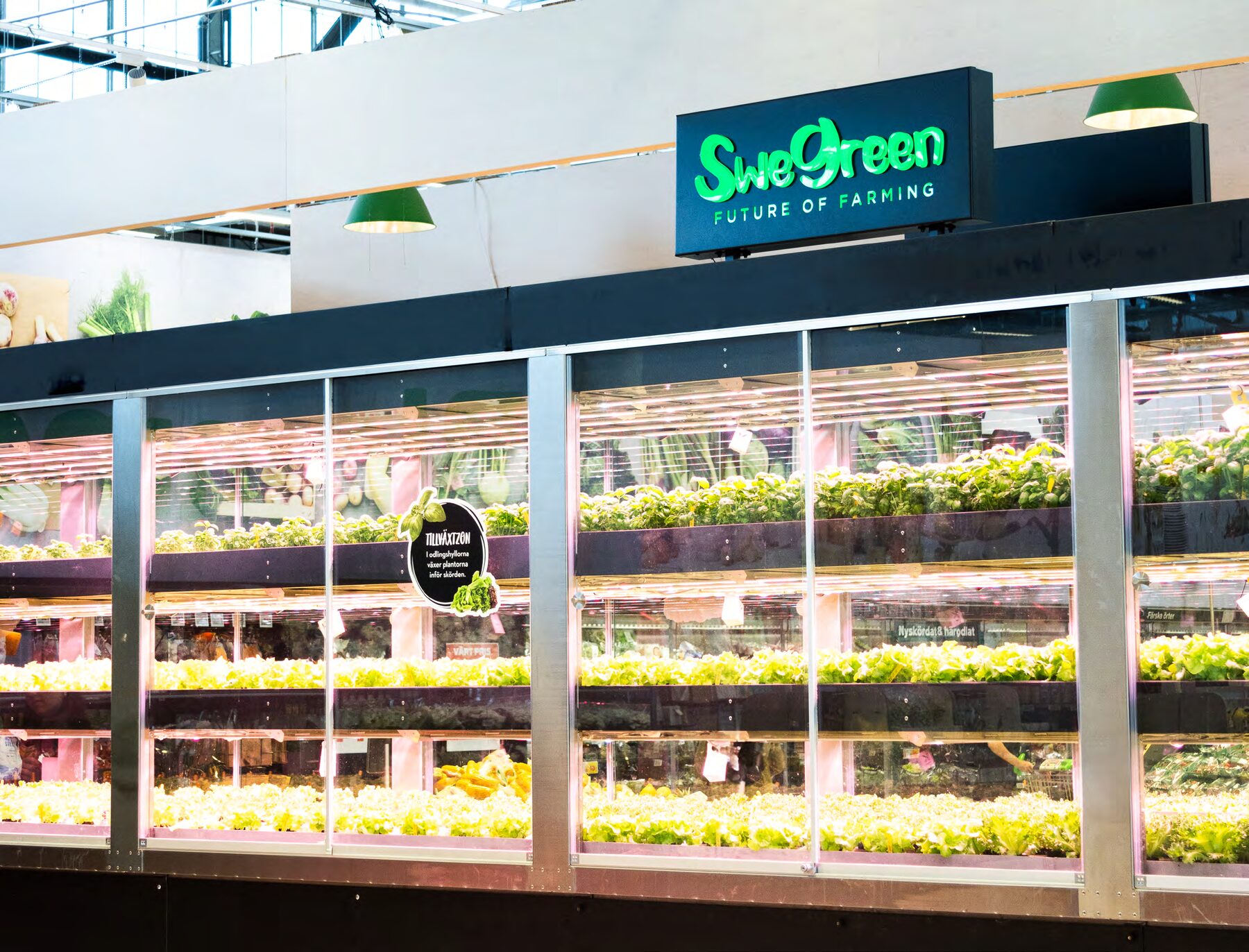
In-store farming means installing vertical hydroponic growing systems directly at the point of sale or service – in supermarkets, restaurants or institutional kitchens. Lettuce, herbs and leafy greens are grown, harvested and sold on-site, often the same day.
Soil-free cultivation in a controlled environment removes the need for chemical crop protection entirely.
Water is recirculated in closed systems.
Production moves close to the consumer and continues uninterrupted even when global supply chains break down.
Crops are harvested at peak ripeness and sold immediately – shelf life up to three weeks, directly supporting EU food waste compliance.
No exposure to freight rates, fuel prices, currency swings or fertilizer price shocks.
In the traditional chain, a head of lettuce passes through eleven steps before it reaches the store shelf. With vertical farming there are five. When the farm is in the store, two remain: growing and the shelf.
| Open field | Greenhouse | Vertical farming | In-store farming | |
|---|---|---|---|---|
| Water (litres) | 50–330 | 16–200 | 0.5–16 | 1.3–1.5 |
| Energy (kWh) | 0.3–1.0 | 5–33 | 2.4–38 | approx. 10* |
*In-store farming: measured electricity use in Swegreen’s farm at Maxi ICA Solna in 2025 – 1.35 kWh per plant, based on a 130 g head of lettuce. For the farm’s full mix, mostly herbs, it comes to about 17 kWh per kg. See the measured data.
Sources: Martin, Elnour & Siñol 2023; Orsini et al. 2020; Karlsson 2023; Borgström & Brandel 2024; Swegreen, own measurement 2025.
Production is concentrated in a handful of regions and supply chains are long and complex. Lettuce can’t be stockpiled, and its short shelf life leaves no buffer when transport is disrupted.
Up to 99 percent less than open-field or greenhouse cultivation. Water is recirculated in closed systems that even recover moisture from the air – about 1.3–1.5 litres per kg of lettuce.
No. Crops are grown without soil in a closed, controlled environment. Without soil, the risk of soil-borne diseases, insects and other pests disappears, so no pesticides are needed.
Yes. The systems are space-efficient, recirculate their water, are digitally controlled and can be set up where people live – independent of season, weather and global supply chains.
No. It is an important complement to building a more robust, sustainable and resilient food system.
Swegreen runs around 20 in-store farms in Swedish grocery retail. We are happy to take part in interviews, panels and policy work on food security, resilience and local food production.